
Parent comforting a tired toddler wrapped in a blanket on a living room couch, with a thermometer, tissues, water, and children’s medicine nearby during home illness care.
It starts the same way every time. You tuck your toddler in, they seem fine, and then 2 AM hits. A hot forehead, labored breathing, or a cry that sounds wrong. Your mind races through the same question: Is this serious enough to call someone?
Every parent knows the dread. The CDC estimates children under 5 average 6 to 8 respiratory illnesses per year, and most clear up on their own. But some symptoms cross the line from “wait it out” to “get help now.” And knowing where that line sits is the difference between a $2,000 ER bill and a $150 urgent care visit, or worse, between catching something early and missing a window.
The trick isn’t memorizing every symptom. It’s knowing the red flags and having a clear plan for what to do when they show up. Here are 7 signs that warrant a call to a medical professional, plus guidance on where to turn for each one.
1. A Fever That Lingers or Spikes

A father checks his child’s temperature on a living room couch while the child rests under a blanket holding a teddy bear, with medicine, tissues, and water nearby.
Fever is the number one reason parents bring toddlers to the ER unnecessarily. A 2026 HSChange analysis found that fever accounts for 50.5% of all nonurgent pediatric emergency visits. That’s more than half of avoidable ER trips driven by one symptom that can often be managed at home.
This is where having access to qualified local nurses makes a real difference. Pediatric offices and urgent care centers staffed with experienced nursing professionals can listen to your child’s symptoms over the phone and tell you whether to come in, head to the ER, or stay home with Tylenol and fluids. That triage guidance alone keeps countless families out of crowded waiting rooms.
The American Academy of Pediatrics, via a guide on HealthyChildren.org, recommends calling your pediatrician if a fever exceeds 104 degrees F, lasts more than 24 hours in a child under 2, or extends past 72 hours in older toddlers. For infants under 3 months, any fever at all means an immediate call.
2. Difficulty Breathing or a Cough That Sounds Wrong
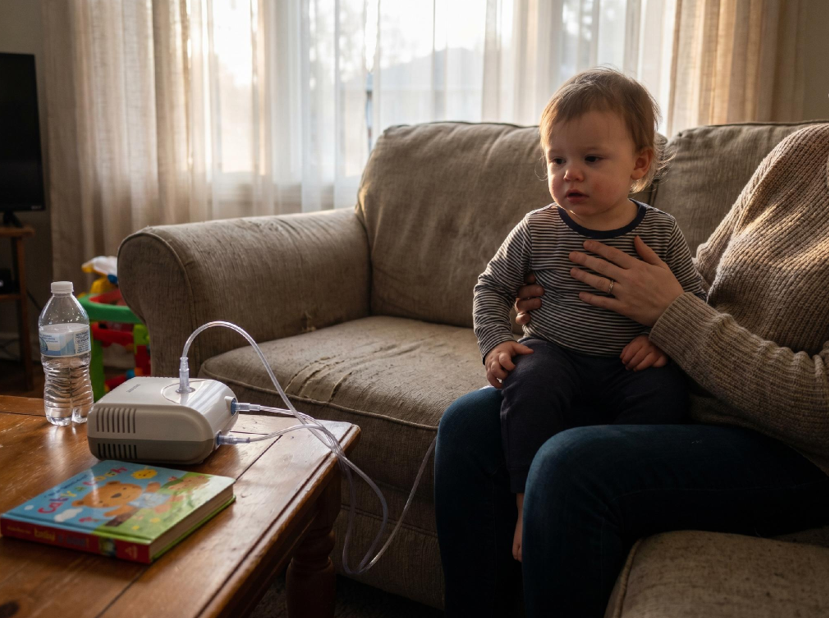
A parent holds a toddler during a nebulizer treatment in a cozy living room, with a children’s book and water bottle on a nearby coffee table.
Coughing and congestion come with every toddler cold. But there’s a difference between a stuffy nose and respiratory distress. Wheezing, rapid breathing where you see the ribs pulling in (retractions), nostril flaring, or grunting with each exhale all signal that your child’s lungs are working too hard.
A 2025 study in Frontiers in Pediatrics found that respiratory system diseases account for 78.7% of all pediatric emergency department cases. The latest UK government data, published in the Child and Maternal Health Profiles in May 2026, show emergency admission rates for children ages 0 to 4 reached 152.5 per 1,000 children, driven primarily by lower respiratory tract infections.
If breathing looks difficult at rest, your child can’t finish a sentence without gasping, or you hear a high-pitched sound when they breathe in (stridor), skip the pediatrician’s office and go straight to the ER. For milder symptoms, a same-day pediatrician visit works fine.
Breathing trouble also affects sleep quality, which our promoting healthy sleep habits for toddlers guide covers in more detail, especially the connection between congestion and restless nights.
3. Signs of Dehydration to Watch For

A toddler drinks water from a blue cup while sitting in a high chair.
Toddlers dehydrate faster than adults because their bodies hold less fluid reserves. Vomiting and diarrhea drain those reserves quickly, and a sick toddler who refuses to drink only makes it worse.
Watch for these signs: dry mouth or cracked lips, no tears when crying, fewer than 6 wet diapers in 24 hours, a sunken soft spot on top of the head, and unusual sleepiness or lethargy. Any one of these symptoms warrants a call to your pediatrician.
The cost difference between care settings matters here too. Treating dehydration at an urgent care runs $150 to $250 on average, with insurance copays as low as $20. An ER visit for the same condition runs $800 to $2,000 or more, according to HSChange’s 2026 cost data. Mild cases respond well to Pedialyte and rest at home, but if your child can’t keep anything down for more than 8 hours or shows signs of moderate dehydration, professional evaluation is the right call.
4. Unexplained Rashes Combined With Fever

A healthcare professional examines a toddler’s arm rash during a pediatric clinic visit while the child sits on an exam table.
Most toddler rashes are harmless. Roseola, hand-foot-and-mouth, and simple heat rashes all look alarming but clear up on their own. The danger zone starts when a rash appears alongside a fever.
The red flag to watch for is a non-blanching rash: one that doesn’t fade when you press a glass against it. That can indicate meningitis, a medical emergency. The Mayo Clinic’s guide on fever notes that fever combined with a rash, especially if your child also has a stiff neck, sensitivity to light, or extreme irritability, warrants immediate medical attention.
If the rash looks like tiny purple or red pinpricks (petechiae) and your child has a fever, don’t wait for a pediatrician appointment. Head to the ER. For rashes without fever, a picture sent to your pediatrician’s office through a patient portal is often enough for guidance.
5. Ear Pain or Persistent Inconsolable Crying
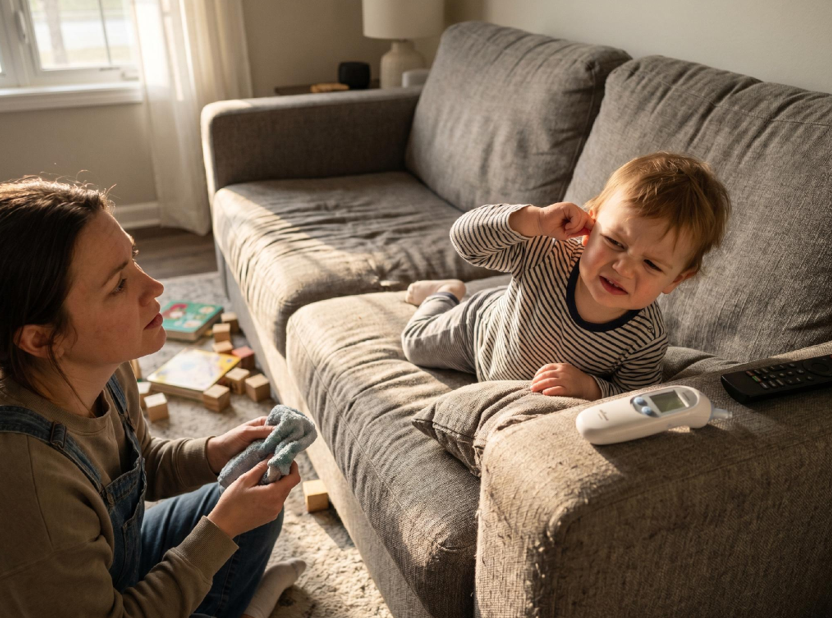
A parent comforts a toddler with ear pain on a living room couch, with a digital thermometer nearby as the child holds one ear in discomfort.
Ear infections peak between ages 6 months and 2 years. The telltale signs are obvious once you know them: tugging or pulling at an ear, trouble sleeping (especially after lying down), fussiness that seems worse when your child reclines, and a fever that appears alongside the irritability.
The tough part is that teething and ear infections share symptoms. Both cause fussiness, disturbed sleep, and a desire to chew or tug. The difference: ear infection pain gets worse when the child lies flat, while teething pain stays fairly constant regardless of position.
If your toddler has ear pain with a fever over 102 degrees F, discharge from the ear, or symptoms lasting more than 48 hours, a pediatrician or urgent care visit is warranted. Many ear infections clear without antibiotics, but a doctor needs to confirm that.
When toddlers are sick and uncomfortable, they can also become harder to soothe. If your child is struggling with ear pain or another illness, our guide on navigating tantrums can help you respond calmly and effectively during moments of extra fussiness and emotional overwhelm.
6. Extreme Fatigue, Confusion, or Unusual Sleepiness
There’s a big difference between “tired from fighting off a cold” and “I can’t wake my child up.” Lethargy is one of the most serious red flags in pediatric medicine.
A toddler who is sleepy but wakes easily, engages briefly, then goes back to rest is probably fine. The danger sign is when they’re difficult to wake: you shake their shoulder and get no real response, or they’re confused and disoriented when they do open their eyes. Other red flags include floppy body tone, blank staring, or not recognizing familiar faces.
This symptom combination can point to serious conditions: meningitis, sepsis, severe dehydration, or a neurological issue. It is not something to watch and wait on. If your child is unusually hard to wake or seems confused, go to the ER immediately. Call your pediatrician on the way.
7. Changes in Eating or Bathroom Habits
Loss of appetite is normal during a cold or stomach bug. Most toddlers won’t eat much for 24 to 48 hours and bounce back. But there’s a boundary between “not hungry” and “can’t keep anything down” that parents need to spot.
Call your pediatrician if your toddler refuses to drink for more than 8 hours, has green or bright yellow vomit (which can signal a bile obstruction), has bloody diarrhea or stool that looks like black tar, or goes more than 48 hours without a bowel movement after their usual pattern.
Severe constipation and gastrointestinal issues account for around 17.9% of pediatric ER visits. Most resolve at home with hydration, dietary changes, and rest. But bloody stools, persistent vomiting, or signs of severe abdominal pain (drawing knees to chest, crying when the belly is touched) need professional evaluation.
Understanding your child’s baseline is key, which is why our article on understanding childhood obesity trends and prevention discusses how tracking eating patterns over time helps parents spot meaningful changes from normal variation.
How to Choose the Right Level of Care

A tablet displays a child illness care guide comparing home care, pediatric visits, urgent care, and emergency room treatment options on a kitchen table.
Every parent needs a mental flowchart for this. Here’s how to sort through the options:
- Home care works for low-grade fevers (under 102 degrees F), mild coughs, runny noses, and normal fussiness. Keep your child hydrated, use age-appropriate fever reducers, and monitor.
- Pediatrician visit is right for fevers over 104 degrees F that come down with medication, ear pain without discharge, mild dehydration that responds to fluids, and persistent symptoms lasting more than 3 days.
- Urgent care fits situations that need same-day attention but aren’t life-threatening: moderate dehydration, ear infections with significant pain, minor breathing issues such as croup, and rashes without fever. Costs run $150 to $250 compared to the ER’s $800 to $2,000-plus, as reported in HSChange’s April 2026 analysis.
- Emergency room is for difficulty breathing that doesn’t improve, non-blanching rashes with fever, seizures, difficulty waking, severe dehydration (no wet diapers for 12-plus hours), head injuries with vomiting, and any symptom you truly feel is an emergency regardless of the list.
One of the most underused resources in pediatric care is the nurse triage line. A study published in the Archives of Disease in Childhood (October 2025) analyzed roughly 972,000 pediatric phone consultations and found that clinically trained health advisors (nurses and paramedics) were 45 times more likely to recommend home care than non-clinically trained staff. The same study showed nurse-led triage reduced emergency department attendance by 36%.
Many pediatricians’ offices and insurance plans offer free 24/7 nurse advice lines. Keep that number on your fridge. A 5-minute call to a qualified nurse can save you a sleepless night in a waiting room and hundreds of dollars.
Trust Your Instincts, but Know the Signs
No parent catches every red flag early. That’s not the goal. The goal is to know which symptoms need action and to have a plan for who to call when they appear.
Fever, respiratory trouble, dehydration, rashes, ear pain, lethargy, and GI changes. These seven categories cover the vast majority of pediatric concerns. When in doubt, call. A quick conversation with a medical professional is always better than hours of anxious Googling. Your toddler’s health depends on your willingness to ask for help, and the right guidance is usually just a phone call away.
 Cynthian Holleyori is a skilled article writer who has been integral to the development of Toddler Health Roll. Her deep understanding of child health and development is evident in her well-researched and practical articles, which provide parents with essential guidance on raising healthy toddlers. Cynthian's contributions have significantly shaped the platform, ensuring that it addresses the most pressing concerns of parents and caregivers.
Beyond her expertise in toddler health and nutrition, Cynthian also delves into the mental and emotional well-being of young children. She offers valuable parenting strategies that help families foster a nurturing and supportive environment for their toddlers. Her dedication to building Toddler Health Roll has made it a trusted and comprehensive resource for parents committed to their children's growth and happiness.
Cynthian Holleyori is a skilled article writer who has been integral to the development of Toddler Health Roll. Her deep understanding of child health and development is evident in her well-researched and practical articles, which provide parents with essential guidance on raising healthy toddlers. Cynthian's contributions have significantly shaped the platform, ensuring that it addresses the most pressing concerns of parents and caregivers.
Beyond her expertise in toddler health and nutrition, Cynthian also delves into the mental and emotional well-being of young children. She offers valuable parenting strategies that help families foster a nurturing and supportive environment for their toddlers. Her dedication to building Toddler Health Roll has made it a trusted and comprehensive resource for parents committed to their children's growth and happiness.